By Adriana Chira
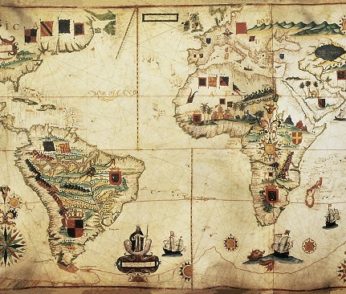
In our geographic imaginaries, Spanish colonialism tends to be mapped onto South America. But the last Spanish colony to claim independence from Spain in 1968 was a territory in West Africa—Equatorial Guinea

a journal of research & art
By Adriana Chira
In our geographic imaginaries, Spanish colonialism tends to be mapped onto South America. But the last Spanish colony to claim independence from Spain in 1968 was a territory in West Africa—Equatorial Guinea

Reviewed by Andrei Rogatchevski
Hůlová’s first-person narrative on behalf of a thirty-something female prostitute attempts to establish the image of prostitutes as women of integrity, who provide a service to society by furnishing their clients with “a bit of humanity.”

Reviewed by Michael Collins
The ambitious aim of Jansen and Osterhammel’s Decolonization is to provide a comparative evaluation of an immensely complex global historical process in a relatively concise volume. The authors revised and expanded their original 2013 German language version for the current text, whose purpose is to explain how the de-legitimation of European colonial rule over Africa and Asia during the course of the twentieth century involved a broad array of structural and normative factors.
Translated by Allison M. Charette
You cannot walk fast in Antananarivo. There’s a weight in the air, a heat that makes everything slow and viscous. There’s a constant small of noxious gas, an acid odor that gets into your lungs, infests your muscles. There’s the red dust, blackened by exhaust fumes, and the perpetual suffocation of the city, so precariously perched, so dry.

By Marcia C. Schenck
It is 2014. The faded flag the German Democratic Republic used from 1959 to 1990 blows in the wind on a makeshift flagpole in the heart of Maputo. It consists of the tricolor: black, red, and yellow, and features the symbols of the worker and peasant state: a compass and hammer encircled with rye.
By Margaret Andersen
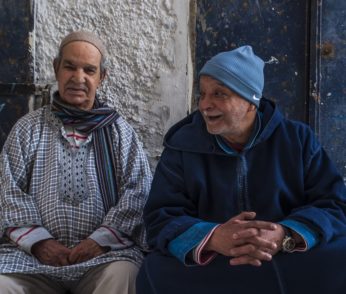
Family allowances became a focal point in debates about rights and equality within a larger imperial framework as Moroccans increasingly traveled to France to work in the postwar period.
By Amy L. Hubbell
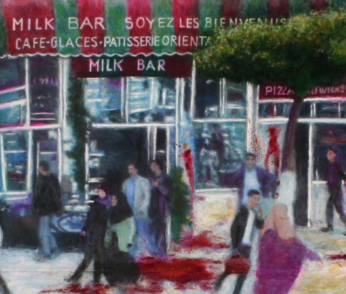
France’s former French citizens of Algeria, the Pieds-Noirs, include one of Europe’s largest diaspora communities in the twentieth century. This diverse group of people settled in Algeria during the colonial years, and after one-hundred and thirty years of French colonial rule, Algeria fought for and won its independence in 1962. The seven-year war was traumatic for both the Algerians and the French living in the colony, and nearly one million people crossed the Mediterranean during and after the war to make a new home in France.
By Anna Arnone and David O’Kane
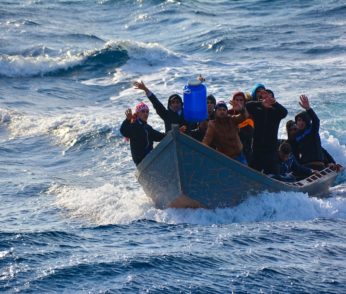
Certain historical incidents can crystallize and condense the reality of an entire era. The mass drowning of at least 500 migrants, mostly Eritrean, near the island of Lampedusa on the third of October 2013, was one such incident. It was part of a wider set of political logics that characterize this era, logics that include those described by Barbara Pinelli in her ethnography of the conditions endured by asylum seekers in the reception centers of the Italian state.

By Thaddeus Sunseri
Although rinderpest was long known in Eurasia, emanating from the central Asian steppes with trade, warfare, and herd migration, its arrival in sub-Saharan Africa in 1888, and subsequent spread throughout the continent over the next decade, is surprising.